


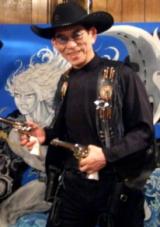
Grew up in Kagoshima Prefecture, Japan. Was an assistant to YOKOYAMA Masamichi. After debut he became one of the cartoonist who built the graphic novel boom through the 1960s and 1970s.
After leaving Yokoyama Productions, he took his American comic-style action works to major publishers, but was repeatedly turned away, with the excuse that his artwork needed to sell better. While he was working at Futabasha , he met Shimizu Fumito, who was the editor-in-chief of Manga Story at the time . He was told, "Ah, this is it. Draw 16 pages for me," and was immediately hired. In 1967 , he made his magazine debut with the one-shot "White Grave" published in the May 13, 1967 issue of Manga Story . He took the name Baron Yoshimoto from the one-shot "Viet Cong Female Leopard" published in the same magazine that same year. (According to him, "the editorial department arbitrarily gave me this name. See episodes for details.)
In 1967, the magazine Manga Action (Futabasha) was launched with Shimizu Fumito as its first editor-in-chief, and Shimizu and Monkey Punch were promoted as two of the biggest new artists. (On the cover, their names were prominently displayed, ahead of other popular manga artists at the time, such as Ishinomori Shōtarō (later known as Ishinomori Shōtarō ), Mizuki Shigeru , and Kojima Isao .)
He has worked on a wide range of manga for young men, including historical dramas, war stories, biographies, gambling, and science fiction. He has also been active in boys' manga magazines, serializing "Black Eagle" and "Rikido-kun" in "Shonen Sunday ."
It began in 1970 (Showa 55), a turbulent year that began with the Osaka Expo and ended with Yukio Mishima 's suicide by seppuku, and was serialized in Manga Action for the next 10 years. It was a hit that represented the 1970s, and this epic manga set in the Meiji to Showa eras and spanning four generations of parents and children was popular with a wide range of generations. For details, see the Jūkyōden series .
In 1980, he visited San Diego Comic-Con with Osamu Tezuka , Monkey Punch, Go Nagai , and others to promote Japanese manga . On the return flight, Tezuka, who sat next to him, suggested that four or five manga artists who occasionally visit the United States pool together 10 million yen each to buy a mansion with a pool. Baron strongly supported the idea of having a base in the United States to publish his works, but ultimately failed to attract enough people, and the plan fell through. However, Baron, already excited about his future in the United States, purchased a 1,800-square-foot house with a pool in Rancho Palos Verdes , a neighborhood in Los Angeles known as "Doctor Hills," where many doctors and lawyers live . He ended all of his serializations and moved to the United States alone .
He went to New York and published his work in a comic book adaptation of Conan the Barbarian , published by Marvel Comics . (This is said to be the first time a Japanese person has published a work in Marvel Comics.) He continued to submit work to Marvel, following a call from Stan Lee . However, instead of American-style stories, he was asked to draw stories about samurai harakiri (serious acts of violence), geisha, and yakuza. It was a time of intense global Japan-bashing , and Baron, who felt discriminated against on a daily basis, rebelliously declined the offer. He subsequently contributed illustrations to Penthouse and other magazines .
After returning to Japan in 1985 , he began painting while continuing to write manga. Around 1990, he began using the pen name "Ryumanji" to describe his work as a painter, concealing the name Baron Yoshimoto, but he had no intention of exhibiting or selling his works .
In 2003 , he was appointed by the Agency for Cultural Affairs as the first Cultural Envoy to Sweden , where he promoted Japanese manga culture through various lectures and events. One of his students at the time was Åsa Ekström , who would later make her debut as a manga artist in Japan . Later, in 2005 , manga author Kazuo Koike approached him about establishing a character design department at Osaka University of Arts, and invited him to teach there. From then until 2013, he devoted himself to nurturing the next generation of artists and creating artwork .
In 2015 , he adopted the pen name Baron Yoshimoto and has been active both in Japan and abroad ever since .
In 2017 , to commemorate the 50th anniversary of his work as "Baron Yoshimoto," an art book titled "Baron Yoshimoto Gakyoden ArtWork Archives" was published by LEED Publishing , edited by fellow manga artist Yamada Sansuke .
In addition, the "Baron Yoshimoto Gakyo Exhibition" was held at Kodaiji Temple in Kyoto , where original artwork was exhibited in the Kitashoin monastery and sliding screen paintings dedicated to Kodaiji Temple were on display in the main hall and abbot's quarters .
In 2019, the year he celebrated his 60th anniversary as an artist, the Yayoi Museum held a special exhibition entitled "Baron Yoshimoto ☆ First Year: 60 Years of Artistic Career Celebration," with talks by Morio Agata , Hiroshi Aramata , Toshio Suzuki , Katsuya Terada , and Sansuke Yamada . In 2019 , he received the Minister of Education, Culture, Sports, Science and Technology Award at the 48th Japan Cartoonists Association Awards .
In 2024, in his 65th year as an artist, he began serializing his manga series " Ah, Wilderness " (originally written by Shuji Terayama ) on ComicPure for the first time in about 20 years . He teamed up again with Katsuya Shirai, who was his former editor at Shogakukan .
KAMOGAWA Tsubame, TAKAJO Masahiko, MIYAJIMA Hibiki and SASANUMA Sugurushi were once his assistants.
