
Suugaku Girl 
Login to add items to your list, keep track of your progress, and rate series!
Description
From author's site:
I love math. Just after the high school entrance ceremony I meet a beautiful girl, Milka. Milka is a mathematical genius. She gives me many math problems and shows me many elegant solutions. Milka and I spend a long time discussing math in the school library.
A year later I meet another mathematical girl, Tetra. Tetra is one year younger than me, and asks me to teach her math. While I teach her, she begins to understand math and to love its elegance gradually."
The first series is about Fibonacci Numbers, Harmonic Numbers, Finite and Infinite Sums, Factorization, The Basel Problem, Partitions of the Integer, and Generating Functions.
Type
Manga
Related Series
Associated Names
Mathematical Girls
数学ガール
Groups Scanlating
Latest Release(s)
v.2 c.14 (end) by Hox 14 years ago
v.2 c.13 by Hox 14 years ago
v.2 c.10-12 by Hox 14 years ago
Search for all releases of this seriesStatus in Country of Origin
2 Volumes (Complete)
Completely Scanlated?
Yes
Anime Start/End Chapter
N/A
User Reviews
N/A
Forum
1 topics, 1 posts
Click here to view the forumUser Rating
Average: 7.4 / 10.0 (115 votes)
Bayesian Average: 7.17 / 10.0
10
17%
9+
13%
8+
16%
7+
26%
6+
14%
5+
7%
4+
6%
3+
0%
2+
1%
1+
1%
Last Updated
October 5th, 2016 12:56am PDT - 9 years ago
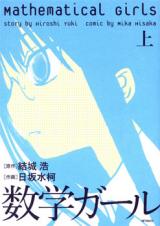
Image [Report Inappropriate Content]
Genre
Categories
Category Recommendations
Recommendations
Author(s)
Artist(s)
Year
Original Publisher
Serialized In (magazine)
Comic Flapper (Media Factory)
Licensed (in English)
Yes
English Publisher
Bento Books (1 Volume - Dropped)
Activity Stats (vs. other series)
Weekly Pos #760  (-30)
(-30)
(-30)Monthly Pos #1719 (-158)
(-158)3 Month Pos #3732  (+357)
(+357)6 Month Pos #5857 (No change)
Year Pos #6058 (-2346)
(-2346)List Stats
On 414 reading lists
On 372 wish lists
On 331 completed lists
On 19 unfinished lists
On 159 custom lists
Note: You must be logged in to update information on this page.
Forum Posts Click to view the forum